


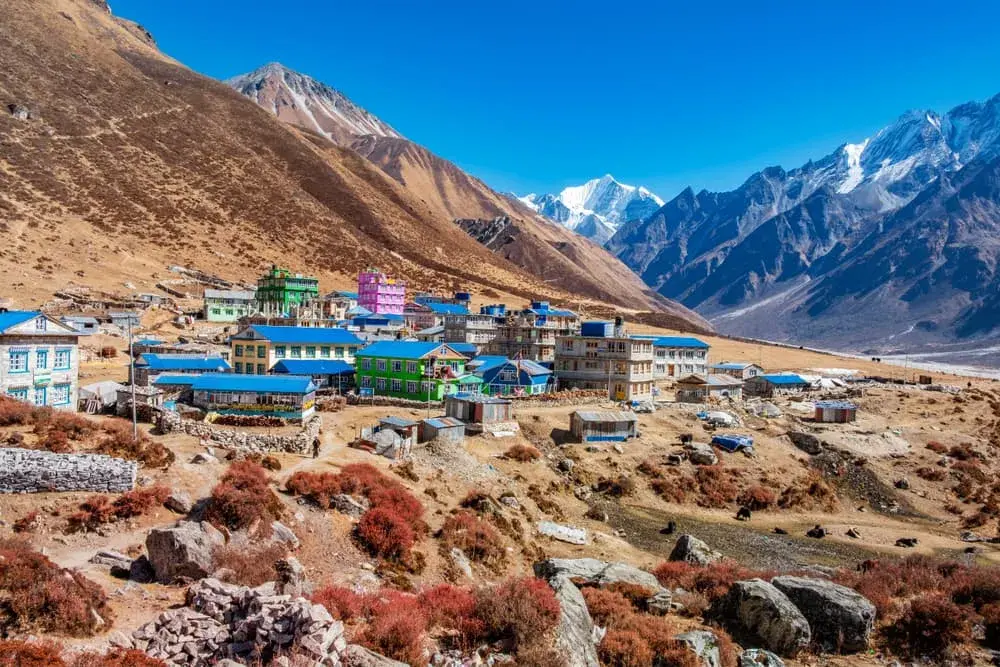
The Langtang Valley trek is the third most popular trekking route and is the closest one to Kathmandu Valley. It is in the middle of the Himalayas and is split into different areas by a network of rivers. The area has high pastures, lush forests, raging rivers, and a lot of different kinds of plants and animals. As it clings to the side of a mountain in the Himalayas’ frozen peaks, the Langtang valley is its own kind of heaven. The Langtang valley is in Langtang National Park, which is the country’s first Himalayan National Park. Tibet is to the north, along the western Bothe Koshi and Trishuli rivers, and the park covers an area of 1710 square kilometres, split between the three districts of Rasuwa, Nuwakot, and Sindupalchowk.
The start of the Langtang Valley Trek
The 11-day Langtang Valley Trek begins with a drive from Kathmandu to the busy village of Syabrubesi. The drive goes along winding roads along the banks of the powerful Trishuli river, passing many busy villages and endless rows of hills in central Nepal. Your trek begins in Syabrubesi. Once you get to Syabrubesi, follow the trail along the river for most of the hike. From Syabrubesi, go towards Bamboo, following a series of waterfalls across the hills and crossing a subtropical wet hill forest of oaks and a mix of other trees. From Bamboo, go towards Changtang, which is where the Lama Hotel is located.
Going to Langtang Valley
Next, you’ll go to Langtang Valley, which is a U-shaped valley with not much vegetation and rings of snow-capped mountains all around it. Through Langtang Valley, you can visit villages, learn about the traditions and way of life of mountain people, climb mountains, and see glaciers all at a comfortable elevation. You can get to Kyanjin Gompa from Langtang valley by going through alpine meadows and high pasture lands. Kyanjin Gompa is the valley’s highest village and a great place to start for a number of interesting day trips. Explore the settlement and then make your way to the famous Tsergo Ri. This is a great place to see the Himalayas because it has great views of Langtang Lirung (7246m) in the north, Gang Chhenpo (6388m) and the peak of Naya Kangri (5846m) in the south, Dorje Lakpa in the east, and you can even see Tibet.
The 11-day Langtang Valley Trek is a great way to learn about the customs and languages of the native people who live in the Himalayas. These people speak the Tibeto-Burman language and have roots in Tibet, where they practise a form of Tibetan Buddhism and Lamaism. Going through thick forests, rivers that look like mirrors, snow-capped mountain ranges, alpine meadows where prayer flags flap in the wind on the sides of hills, and high mountains that send prayers up into the sky. Join The Alpine Club of Himalayas on their Langtang Valley Trek.
Food and water:
On the Langtang Region Trek, you can choose from a variety of Nepali, Tibetan, and western meals. There are several teahouses in the area, and most of them are run by locals and have only the most basic amenities. Try a variety of traditional foods and snacks, such as cheese, Churpi, and other milk-based treats and baked goods made in the area. Sea buckthorn juice is also delicious and comes from the Himalayas.
Also, drinking water taps have natural, untreated water supplies, so it’s not a good idea to use the water directly. Instead, you can refill your water bottles with boiling water or cold filter water from any of the teahouses. You can buy a water purification tablet, chlorine drops, or use SODIS (sunlight assisted) filtration methods to be even safer, save money, and cut down on plastic pollution.
Accommodations:
Trekking lodges and teahouses are set up along the trail about every hour or so and offer basic rooms, food, and electricity. There is a single bed and two beds that can be used together in the room. The room is clean and has good mattresses that make your backpack lighter. Most places to stay have a central heating system that is powered by firewood placed in the dining rooms. This gives travellers a place to rest and share their stories. There are also camping spots along the trail, which is a great option for campers.
When is the best time to go?
Autumn and spring are the best times to go trekking in the Langtang region.
The best times to go are in September, October, November, March, April, and May. It is easier to see and the weather is better during these months, making them good for exploring high mountain areas.
The months of September, October, and November in the autumn are great for trekking in the high Himalayas because the weather is clear, you can see a lot, and it’s warm.
The best time to visit Langtang valley is also in the spring, in March, April, and May. When winter ends, the landscape changes, with a mix of trees that bloom with rhododendrons, conifers, oaks, orchids, and ferns, as well as high pastures covered in colourful wildflowers and mild, clear weather.
People who like to trek usually avoid the monsoon season because the weather is bad and it’s hard to get around the country.
In the winter, the area gets a lot of snow, which covers most of the trail. Most of the Langtang region is also closed off, which makes it impossible to hike to higher elevations.
At the Alpine Club of Himalaya, your safety is the most important thing to us. We can cancel the trip or change the plans at any time if we think it’s necessary or if we have reason to believe that your safety is at risk. When travelling in remote mountain areas, things like bad weather, natural disasters, the health of a group member, and other things can cause changes to the plan. We kindly ask that you fully support the trusted leader of the group chosen by the Alpine Club of Himalaya in these very dangerous situations. We promise, though, that we will do everything we can to stick to the above schedule.