

Overview
Duration
16 Days

Country
Nepal

Maximum Altitude
5455 (kala Patthar)

Group Size
Min. 1 Pax

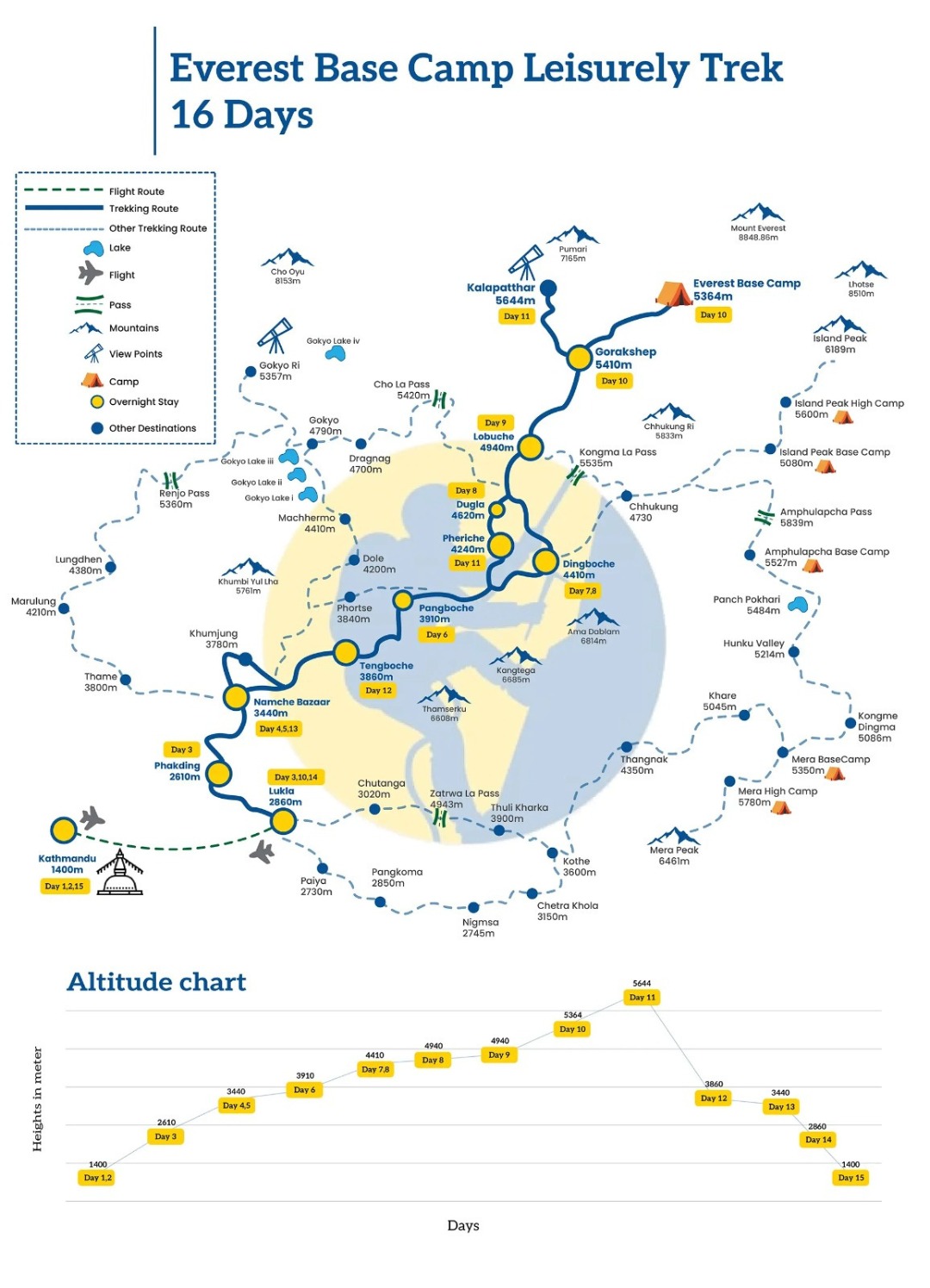
Everest Trekking: The Everest Base Camp A leisurely 16-day trip that combines stunning views of the world’s highest mountains with the unique culture of the Sherpa people who live in a large area with few people. You’ll start your trip with a flight from Kathmandu to Lukla, a cute town with amazing views of the Himalayas. You’ll start your Everest Base Camp trek as soon as you land at the Lukla airstrip. The hiking trails in the area are well-marked, and tea houses offer a range of services. Going along this well-known path will lead you to the villages of Phakding, Namche, Tengboche, Dingboche, Gorakshep, and finally the base camp.
At every turn on the Everest Base Camp Leisurely Trek, there are stories to be told. You will see some of the most beautiful places on earth and feel like your travels are coming to life. You’ll see something different if you take the back road in this place as well. This Everest Base Camp Leisurely Trek will show you the part of the country that does what it does best: it makes you fall in love with both the mountains and the people you meet.
The base camp for Everest Luxury Trek takes you along the same historic trails that famous climbers like Sir Edmund Hillary and Tenzing Norgay Sherpa used to make their famous climb to the top of Mount Everest. This classic route has a lot of history as a mountaineering trail. In the past, it was also an important route for traders and merchants.
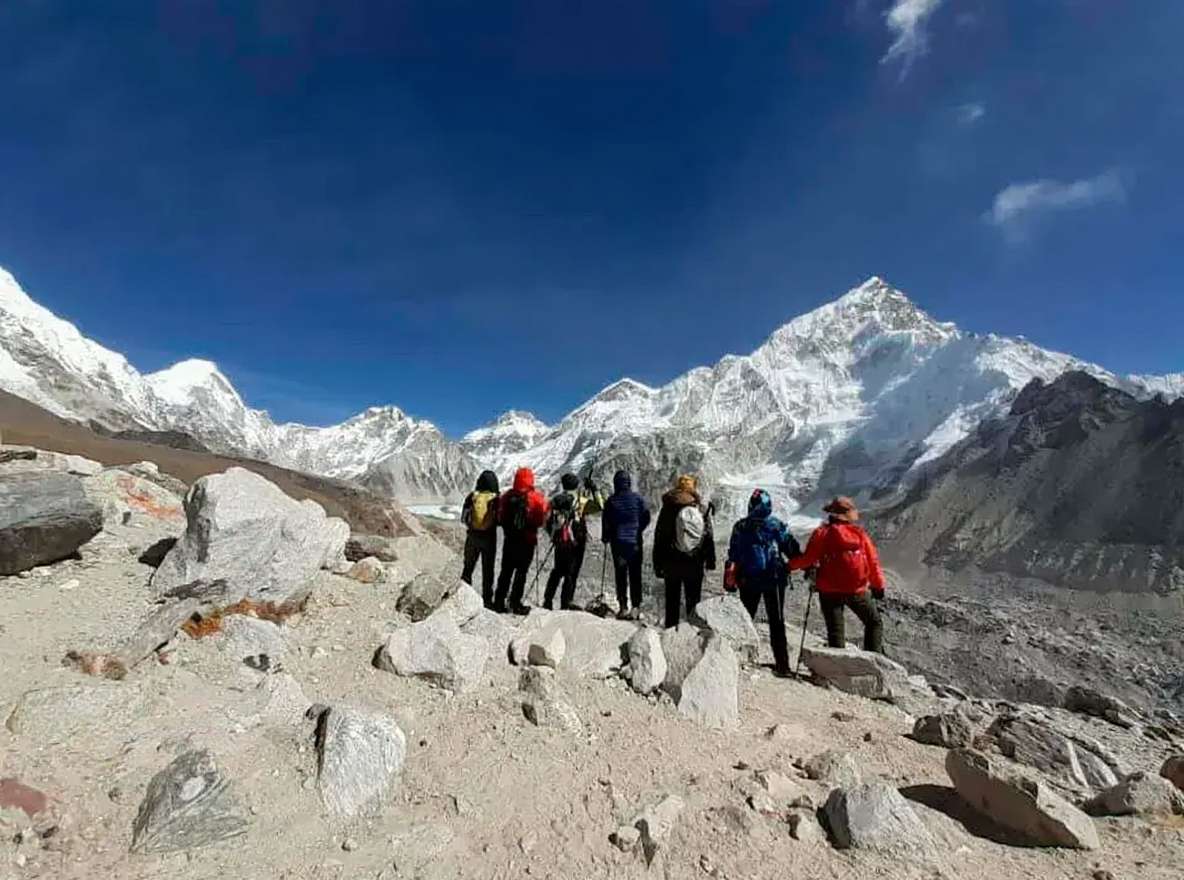
During the walk, you’ll see a lot of different and interesting landscapes. The trail goes through thick, lush forests, remote alpine areas, and rough mountain terrain. You’ll walk on glacier moraines, go through the folds of old glaciers, and be amazed by the clear lakes and roaring rivers.
This easy trek lets you enjoy the Himalayas at your own pace, letting you fully immerse yourself in the magnificent natural beauty and rich cultural history of the area. You’ll be able to see new views, meet interesting people, and make memories that you’ll never forget when you travel.
At the Alpine Club of Himalaya, your safety is the most important thing to us. We can cancel the trip or change the plans at any time if we think it’s necessary or if we have reason to believe that your safety is at risk. When travelling in remote mountain areas, things like bad weather, natural disasters, the health of a group member, and other things can cause changes to the plan. We kindly ask that you fully support the trusted leader of the group chosen by the Alpine Club of Himalaya in these very dangerous situations. We promise, though, that we will do everything we can to stick to the above schedule.
rewrite this but take refereces from the eearlier paragrpahs i sent you and make it more seo friendly
Gallery
Itinerary
The flight into Nepal is beautiful, with views of mountains and hills that never end. As soon as you get to Kathmandu International Airport and finish the immigration process, a representative from the Alpine Club of Himalaya will meet you and drive you to your hotel. You are free to go on your own for the rest of the day.


Max. Altitude:
1,400 meters/4593 feet

Hotel

Meal
N/A
After breakfast, you will go on a full-day tour of Kathmandu valley, which is also called the “city of glory.” You can choose from many things to see and do in the valley. One option is to go to Durbar Square, which is the centre of religious and cultural life and is full of old temples and palaces with beautiful old architecture that are historically important. Kal Bhairav, Hanuman Dhoka, Taleju Temple, Kasthamandap, and Kumari Ghar, which is home to the Living Goddess, are some of the places to see.
Then, head to Swoyambhunath Stupa, which is also called the “monkey temple” and is said to be one of the oldest Buddhist stupas in the world. It is majestically set high on a hill overlooking Kathmandu Valley and has a view of the mountain ranges to the north. Next, go to the Pashupatinath Temple, which is a Hindu temple dedicated to Lord Shiva. This huge temple complex is on the holy Bagmati River. The courtyard of the temple is only open to Hindus. Tourists can see the temple from the eastern shore of the Bagmati River. We will later go to Boudhanath, which is another Buddhist Stupa and one of the world’s biggest. This huge building stands tall and has four sets of eyes, one facing each of the four cardinal directions. These eyes watch over people to make sure they behave well and that everyone gets ahead.

Max. Altitude:
1,400 meters/4593 feet
Hotel
Meal
Breakfast, Lunch, Dinner
Early in the morning, you can take an exciting flight from Kathmandu Airport to Lukla and see views of huge mountains. Your trek begins in Lukla, a beautiful Sherpa settlement on top of a mountain. From Lukla, go to Phakding and then descend to the Dudh Koshi River. Along the way, you’ll pass through the settlements of Chheplung, Ghat, Sano, and Thulo Gumela, as well as the Chorten and monasteries of Drangdrak Gompa and Pema Choling Gompa. From these places, you can see the sacred mountain peaks of Kumbila and Kusum Kanguru. No one is allowed to climb this holy mountain, which makes it one of the few peaks in the Khumbu area that hasn’t been climbed yet.
At a height of 2,610 meters, Phakding is a small Sherpa village that is hidden in the middle of the Dudh Koshi Valley. When you get to the settlement, go to your tea house to rest. After you’re done, go explore the area.


Max. Altitude:
2,860 m (Lukla) / 2,610 m (Phakding)
Hotel
Meal
Breakfast, Lunch, Dinner
Today you’ll be heading to Namche Bazar known as the “Sherpa capital”. After breakfast head to the trail crossing through the hamlet of Zamphute and Tok Tok witnessing rays of morning sun dazzling Thamserku peak. The trail passes the Dudh Koshi, a milky glacial river up to Monjo crossing number of suspension bridges and the iconic Hillary Suspension Bridge .
Arrange your permits for inspection before you approach the Sagarmatha National Park entrance a UNESCO world heritage site, after your permits are checked head down alongside the Dudh Koshi River to Jorsale. After a brief rest, head towards Namche Bazaar on an uphill trail on a steep path to an amazing high bridge over the Dudhkoshi River gorge, and just before this bridge, the Dudhkoshi is met by its tributary, the Bhote Koshi. As you gain altitude, you’ll catch your first glimpse of Mount Everest peering over the Lhotse-Nuptse ridge, from here Namche is a short hike away.


Max. Altitude:
3,440 m
Hotel
Meal
Breakfast, Lunch, Dinner
Today is your acclimatisation day in Namche Bazar. As you climb higher, your body needs to get used to breathing in thinner air. The settlement has a number of good spots for acclimatisation hikes.
At dawn and dusk, go to any vantage point to see the most beautiful view of the Himalayas. The sun shines on Mount Everest, Ama Dablam, Thamserku, Kongde, and Lhotse, which all have snow on their peaks. After that, go to the Sherpa Culture Museum to learn about the traditions and culture of the Sherpa people.
The best bakeries, cafés, restaurants, and shops around Namche are in the afternoon. You won’t find these places on most trekking trails in the country.
Max. Altitude:
3,440 m
Hotel
Meal
Breakfast, Lunch, Dinner
From Namche, take the level, easy trail that goes around the ridge from Chhorkung. From Thamserku to Ama Dablam, Lhotse, and Everest, you can see a huge panorama of peaks along the way. By following the trail, you’ll reach Kyangjuma at an elevation of 3,550 meters. From here, it’s just a short walk to Sanasa at an elevation of 3,600 meters, where you can pick up the trail to Tengboche, which goes gently downhill to the river.
Along the way, the trail slowly goes down to Lawichasa, with Mt. Ama Dablam rising high above it. From Lawichasa, a narrow path goes north to Tashinga (3380m). It then goes down steep stone steps to Phunki Thenga (3250m), where you’ll cross a bridge.
From the bridge, the trail goes up past some prayer wheels that are powered by water and starts a steady climb through a forest of rhododendrons. Watch out, because there are musk deer and Himalayan Thar hiding in the trees. You’ll find Mani walls and a pair of chortens if you keep going down the path. The beginning of Tengboche village is spread out over a wide, grassy saddle that lies below a crescent-shaped ridge that is covered with scrub pines and rhododendrons. The famous Tengboche monastery is the centre of Tengboche. After you check in at your tea house, go to the monastery and look around the area.
Max. Altitude:
3860 meters
Hotel
Meal
Breakfast, Lunch, Dinner
After an early breakfast, the trail follows the Imja Khola up to the village of Shomare and across the tree line. From there, the landscape changes to arid, dry areas with patches of conifers, scrub and lone pastures. From here, cross the grazing lands with scattered stone huts, going past the settlements of Orsho and Tsuro Wog. The trail then goes down to a place near where Imja Khola and Khumbu Khola meet. After finally climbing a short ridge, you’ll reach the large village of Dingboche. This is a cold, windy area where the nights are often below zero, even in the summer.

Max. Altitude:
4410 meters/14468 feet
Hotel
Meal
Breakfast, Lunch, Dinner
Today is your second day of getting used to the altitude. The settlement has a number of great spots for acclimatisation hikes. Go on a walk to Nagarjuna Peak (5,089m) after breakfast. It was a big deal for me because I was able to climb Nagarjuna Peak, which is 5,089 meters high and is my first peak above 5,000 meters. This was part of my day to get used to the altitude before going to Lebuche Village, which is at 4,900m. After that, we’ll go back to the hotel and have the rest of the evening to ourselves. Spend the night. Breakfast, lunch, and dinner
Max. Altitude:
(4410 meters/14468 feet),5,089m
Hotel
Meal
Breakfast, Lunch, Dinner
On today’s trail to Lobuche, you’ll be in the Himalayas, with mountains on all sides that will take your breath away. You’ll pass through Dusa, where you’ll see the uninhabited stone huts of herders. From here, head towards Dughla, and then to Chupki Lhara, where you’ll see memorials made of large rocks with prayer flags on them for the mountain climbers who died trying to reach the top of Mt. Everest and other peaks in the area. After a short climb, you’ll be able to see the clear blue waters of Chola Lakes. The trail goes down from Chupki Lara to the Khumbu glacier moraine. You can walk along the three big peaks, Khumbutse, Lingtren, and Pumori. After one last stretch along a gurgling stream, you’ll reach the village of Lobuche.

Max. Altitude:
4940
Hotel
Meal
Breakfast, Lunch, Dinner
The trek today is long and hard, so you should get up early. The first part of the trek takes you through high Himalayan pastures and grassy areas with rocks and boulders all over the place. All the way, you can see the snowy walls of high mountains in the distance. You have to climb 60 meters (200 feet) to get to the top of the lateral moraine wall of the Changri glacier. This will put you on a flat area called Thangma Riju from which you can see the Himalayan giants Taboche, Lobuche, Pumori, and the rest of the Mahalangur Himal peaks, as well as Tibet and Nuptse in the east.
From here, the trail goes across the Changri glacier moraine and then joins the Khumbu glacier from the west. To get to Gorak Shep, you’ll have to walk on steep, rocky slopes, so be extra careful. You’ll get your first look at Kala Patthar when you get to Gorak Shep.
Leave your heavy backpack at Gorak Shep and walk along the shallow blue waters of Gorak Shep lake to reach Everest Base Camp. Along the way, you can see the Changtse peak and the Lho La peak. To get to Everest Base Camp, you have to go through glaciers, icefalls, frozen pools of meltwater, icy walls that are out in the open, and big rocks. After checking out the base camp, go back down to Gorak Shep for the night.

Max. Altitude:
5364m (EBC)
Hotel
Meal
Breakfast, Lunch, Dinner
Today, you will be going to the famous view point of Kala Patthar, which is often crowded with hikers. After a light breakfast, get up early and walk along the wide, sandy bed of a dried lake, along a steep, winding trail, and up a steep trail to see views of Lingtren, Khumbutse, and Changtse. As you go higher, you’ll get a better look at the Khumbu glacier and the Nuptse massif. On the last stretch to the top of Kala Patthar, you’ll see views of Mt. Everest and many other high mountains. Spend a short time at the top, then go back to Gorak Shep and Lobuche. From Dughla, take a different path along Khumbu Khola to get to Pheriche. When you get to Pheriche, go to your tea house to take a break.


Max. Altitude:
5555m
Hotel
Meal
Breakfast, Lunch, Dinner
After crossing a bridge over the Khumbu Khola, the trail goes down to Tsuro Wog from Pheriche. From Tsuro Wog, you’ll start going down again, passing through the settlements of Orsho, Shomare, upper Pangboche, and finally Tengboche. The world-famous Tengboche monastery is in Tengboche village. It is the largest monastery in the Everest region and has views of Mt. Everest, Nuptse, Lhotse, Ama Dablam, and Thamserku. After you check in at your tea house, go out and see the area.


Max. Altitude:
3860m
Hotel
Meal
Breakfast, Lunch, Dinner
From Tengboche, go to Phunki Tenga and then go down to Sanasa and Kyangjuma. Finally, come back to Namche Bazar. There are miles and miles of undergrowth along the trail. The forest is a subtropical wet hill forest with rhododendrons, conifers, oaks, and trees covered in orchids and moss. When you get to Namche Bazar, go to your lodging first, then go out and explore the area. There are many restaurants and pubs in the area.

Max. Altitude:
3440m
Hotel
Meal
Today, start your walk down to Namche Bazaar along the Dudh Koshi River. Before you get to Lukla, you’ll cross several suspension bridges and see a number of old monasteries and settlements. When you get to Lukla, take some time to rest and enjoy your last day in the mountains.

Max. Altitude:
2860m
Hotel
Meal
After breakfast early in the morning, go to Lukla Airport and take a flight back to Kathmandu. The flight from Lukla to Kathmandu looks like a lot of fun. When you get to Kathmandu, you’ll be driven to your hotel. There are many places to visit in the valley. You can go on a guided tour or go on your own to see the city. In the evening, join your guide and our representatives for a special dinner show to mark the end of your adventure.
Max. Altitude:
1400m
Hotel
Meal
You are going back to your country today. Someone from the Alpine Club of Himalaya will pick you up at the airport three hours before your flight. If you’d like to stay longer, you can talk to us about short tours like game drives in national parks, rafting, mountain biking, tours of Tibet, India, or Bhutan, and more.
Foods: Breakfast
Please feel free to contact Alpine Club of Himalaya if you have any questions or need help or more information about this trip or any other trip.
Note that all of the above trekking times are estimates and should only be used as a general guide.


Max. Altitude:
Hotel
Meal
Official Everest Base Camp Trek Map