


Overview
Duration
11 Days

Country
Nepal

Maximum Altitude
Annapurna Base Camp (4,130m/13,545ft)

Group Size
Min 1 pax

Activities
Trekking

Annapurna Base Camp Trek is a shorter trip for people who are short on time. If you want to get the most out of your adventure, you can choose the longer Annapurna Sanctuary Trek – 14 Days.
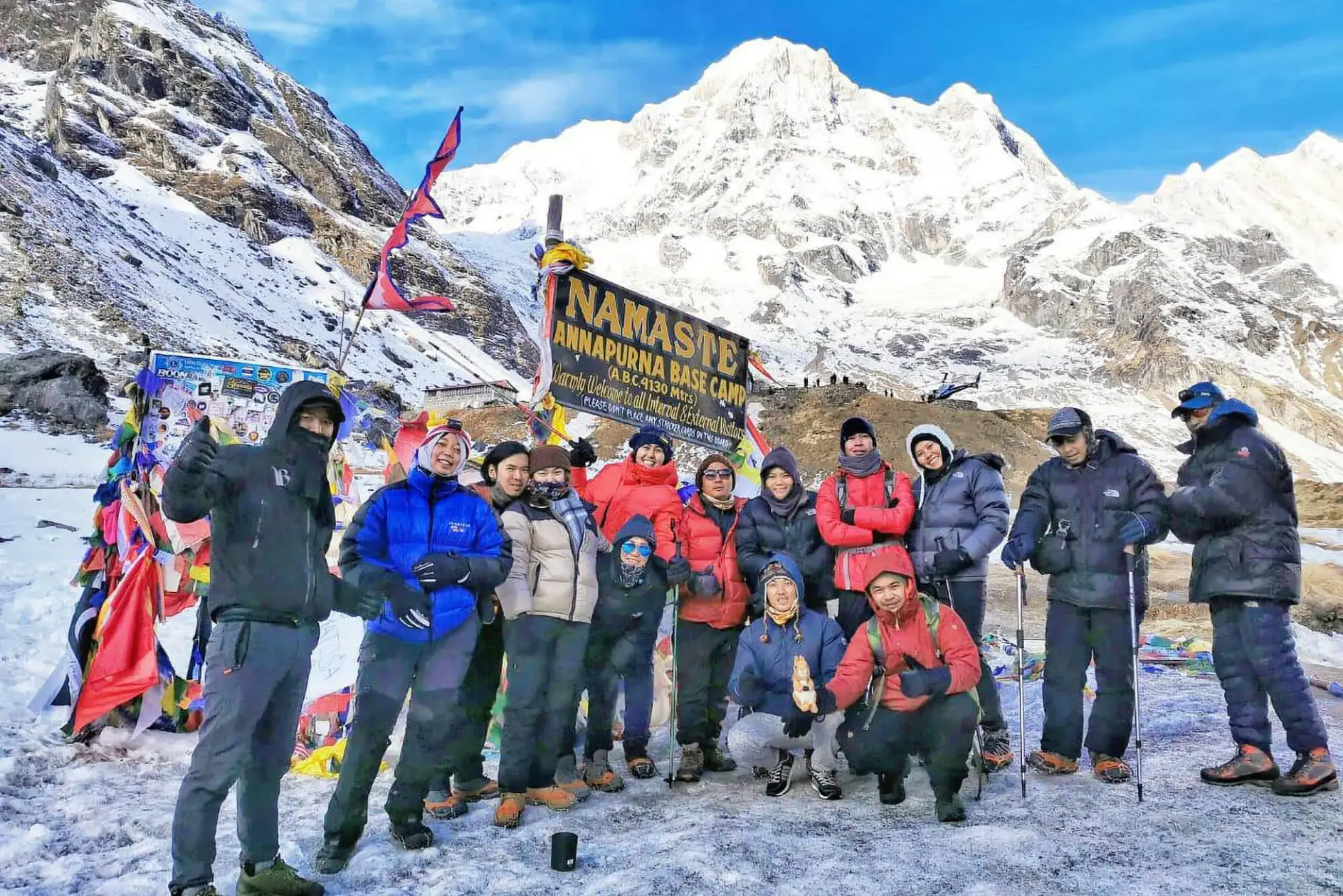
Annapurna I is the 10th tallest mountain in the world, at 8,091 meters (26,545 feet) above sea level. You can join the Alpine Club of Himalaya’s trekking trip to reach it. This mountain range has thirteen peaks higher than 7,000 meters and sixteen more higher than 6,000 meters. One of these is Annapurna 1. Pokhara, also called “Lake City,” is where our trip starts. Dhaulagiri, Manaslu, Machhapuchhare, and Annapurna will all look beautiful from that point of view. From here on out, we’ll see waterfalls, pretty villages, and farmlands with terraces. We will also walk through lush rhododendron forests and end up surrounded by beautiful mountains.
Drinking water and meals:
During the Annapurna Base Camp Trek, you’ll be served a variety of continental and western meals as well as Nepali and Tibetan dishes. Along the trail, there are a number of tea houses that are run by people from the area. There is a range of facilities at these places, from the most basic to the most luxurious. You’ll also be able to try different kinds of food, which is something you might not be able to do on other trekking trails in Nepal.
As of now, the Annapurna Region does not allow the use of plastic bags or mineral water bottles. Along the trekking trail, however, there are drinking water taps with natural water sources that have not been treated, so it is not advisable to drink the water directly. You can refill your water bottles with boiling water or cold filter water at any of the teahouses along the trail.
If you want to be even safer, save money, and help clean up the environment, buy a water purification tablet, chlorine drops, or use SODIS (sunlight assisted) filtration methods.
Accommodations:
Hotels, lodges, and local homes that are friendly to tourists can be found along trekking trails. These can range from simple to fancy and luxurious. Along the trail, you can also find high-end hotels and teahouses that fit your budget. These places also have nice beds with pillows and electric blankets, as well as free WiFi, hot and cold showers, and many other nice touches.
The teahouses in the Annapurna region have hot showers and western-style bathrooms that are attached to the rooms. The rooms usually have a single bed, good mattresses, a pillow, and blankets, and there is a clean and healthy atmosphere.
Along the trail, there are also campsites that offer campers a unique chance to sleep under the stars.
The Alpine Hotel Nepal in Kathmandu, the Hotel Splendid View in Pokhara, and teahouses along the way will be where we stay. All of the rooms are shared between two people. You can ask for a single supplement, which will be served upon request and cost an extra USD150. The Alpine Club of Himalaya will set up rooms with bathrooms right next to them. In some places, though, teahouses only have shared bathrooms and places to wash up. Also, keep in mind that single rooms are easy to find in Kathmandu and the trekking areas at lower elevations but harder to find at higher elevations.
Best Time to Go on a Trek to Annapurna Base Camp?
This area’s best times to go trekking are in the autumn and spring.
The best times to go are in September, October, November, March, April, and May. In terms of weather and visibility, these months are better.
The months of September, October and November in the autumn are some of the best for trekking in this area. The weather is clear, so you can see the endless mountain ranges and lush green forests clearly, and the nights are clear, so you can look at the stars.
The best time to visit the Annapurna Region is also in the spring, in March, April, and May. When winter ends, the region changes, with different kinds of trees blooming in the sub-alpine forest, high green pastures covered with wildflowers, mild temperatures, and clear skies. At this time of year, you can see flocks of sheep and yaks grazing in the lush highlands.
The monsoon season is not good because the weather is bad and it’s hard to get around the country because of the frequent rainstorms and landslides. So trekkers try to avoid the monsoon season as much as possible.
In the winter, the Annapurna Region gets a lot of snow, which covers most of the trails and makes it impossible to travel.
At the Alpine Club of Himalaya, your safety is the most important thing to us. We can cancel the trip or change the plans at any time if we think it’s necessary or if we have reason to believe that your safety is at risk. When travelling in remote mountain areas, things like bad weather, natural disasters, the health of a group member, and other things can cause changes to the plan. We kindly ask that you fully support the trusted leader of the group chosen by the Alpine Club of Himalaya in these very dangerous situations. We promise, though, that we will do everything we can to stick to the above schedule.
Gallery
Itinerary
When you get close to Kathmandu, you’ll be greeted by a stunning view of the Himalayas. Someone from the Alpine Club of Himalaya will meet you at the airport and make you feel welcome. In the evening, you will be served delicious, authentic Nepalese food that will teach you about the food and culture of the country.


Max. Altitude:
1400m

Hotel

Meal
Welcome Dinner
We are going to fly to Pokhara. The best view of the Himalayas will be from the right side of the plane. At the Pokhara airport, someone from the Alpine Club of Himalaya will pick you up.
Then we start our walk by driving on the main road near Birethanti for an hour and a half to Nayapul (new bridge). We walk from Birethanti to Ghandruk, a lovely village where most of the people are Gurung. You can go to the Gurung museum if you have time.


Max. Altitude:
1940 m
Hotel
Meal
Breakfast, Lunch, Dinner
It takes us about an hour to climb up to Kimrungdanda, where we can see Annapurna South, Hiunchuli, Fishtail Mountain (Machhapuchhre), and Ganggapurna. After that, we go down steeply to the Kimrong Khola. We go up steeply again from Kimrong Khola to Chere Danda, then go down for a while. From there, it’s a gentle walk to Chhomrong, a beautiful village in the lap of the huge Annapurna.


Max. Altitude:
2170m
Hotel
Meal
Breakfast, Lunch, Dinner
There are 2500 stone steps that lead down to the bridge above Chhomrong Khola, which we cross. It is a climb up from here to get to Sinuwa. Next, we’ll walk through a lovely forest to get to Kuldihar. From there, it will only be a short walk downhill to Bamboo.
Max. Altitude:
3210m
Hotel
Meal
Breakfast, Lunch, Dinner
We walk through a wet and cold bamboo forest and then slowly climb up a few steep parts. You can see the glacial river below from the Himalaya Hotel, where the forest opens up to the sun. Then we go up steeply through a much drier forest until we reach Hinku Cave. From there, the trail drops down to the river and then goes up again to Deurali, which is the most beautiful part of the day. There isn’t as much vegetation, so you can get a great view of the valley, the river below, and the steep cliffs above that are dotted with thin waterfalls.
Max. Altitude:
3230m
Hotel
Meal
Breakfast, Lunch, Dinner
We slowly make our way up a riverbed and then up a steep trail to the mountainside. From Bagar to Machhapuchhre Base Camp, the hike is a bit difficult. The base camp gives us great views of Mt. Hiunchuli, Gangapurna, Annapurna South, Annapurna I, and Annapurna III, as well as the beautiful Machhapuchhre. After that, there is less vegetation, and as we get closer to the Annapurna sanctuary, the path gets wider. It’s amazing to see the almost vertical south face of Annapurna so high above us from here.
The sanctuary has a beautiful view that goes around in a circle without any obstructions. Again, from the base camp, we can enjoy stunning views of Hiunchuli, Machhapuchhre, Annapurna South, Annapurna I, and other peaks.


Max. Altitude:
4130m
Hotel
Meal
Breakfast, Lunch, Dinner
If you get up before dawn, you can enjoy the beautiful view of the sun changing the white snow-capped peak into a rainbow of colours.
You should go back to Bamboo after taking in the views of Machhapuchhre, Mt. Hiunchuli, Annapurna South, Annapurna I, Annapurna III, Gandharvachuli, and Gangapurna. Along the way, you’ll pass through lush forest areas and a number of settlements.
As you go further, the scenery changes from mountainous areas to subtropical forests. When you get to Bamboo, take it easy and enjoy the views of the area.
Max. Altitude:
2350m
Hotel
Meal
Breakfast, Lunch, Dinner
From Bamboo, you have to walk uphill to get to Kuldighar and then walk downhill to get to Chhomrong Khola. After that, we go up the stone steps to Chhomrong. After going up, the trail goes down to Jhinu Danda, where we will spend the night. You can also walk downhill for 15 to 20 minutes to get to the hot springs.
Max. Altitude:
1760m
Hotel
Meal
Breakfast, Lunch, Dinner
We walk from Jhinu Danda to Nayapul and enjoy the beautiful hills of western Nepal along the way. We take a car from Nayapul to Pokhara. Stay the night in Pokhara.

Max. Altitude:
1070m
Hotel
Meal
Breakfast, Lunch, Dinner
We walk from Jhinu Danda to Nayapul and enjoy the beautiful hills of western Nepal along the way. We take a car from Nayapul to Pokhara. Stay the night in Pokhara.

Max. Altitude:
1400m
Hotel
Meal
Breakfast, Lunch, Dinner
You are leaving today for the country you want to visit. Three hours before your flight, someone from the Alpine Club of Himalaya will take you to the airport. Say goodbye to Nepal and the new people you met.
Please feel free to get in touch with us if you have any questions or need help or more information about this trip or any other trip.


Max. Altitude:
Hotel
Meal