


Overview
Duration
11 Days

Country
Nepal

Maximum Altitude
4,984m (16,353ft) at Tsergo Ri

Group Size
Min 1 pax

Activities
Trekking

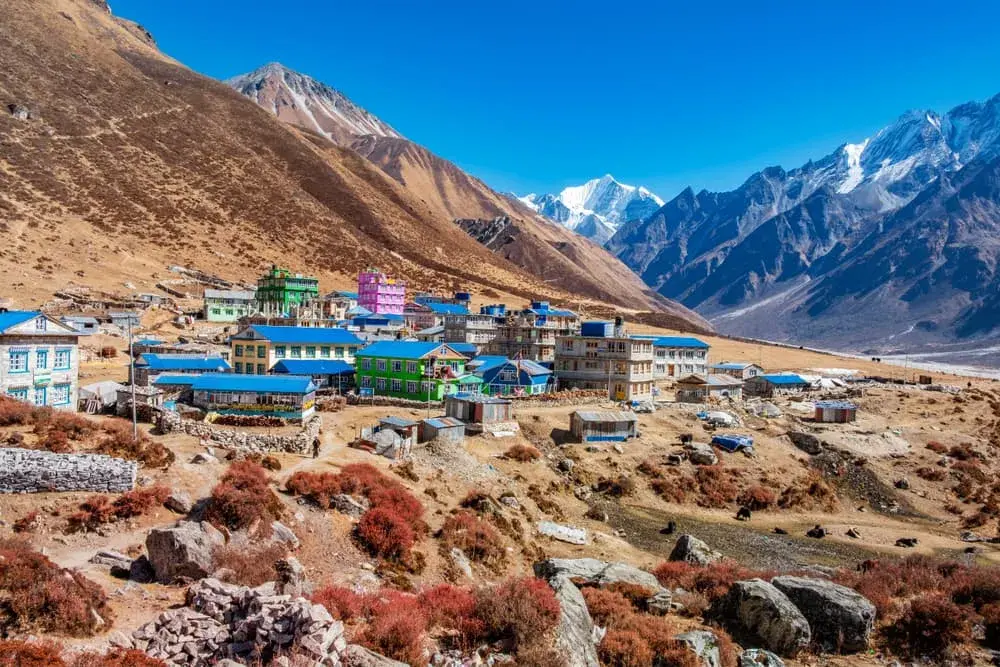
The Langtang Valley trek is the third most popular trekking route and is the closest one to Kathmandu Valley. It is in the middle of the Himalayas and is split into different areas by a network of rivers. The area has high pastures, lush forests, raging rivers, and a lot of different kinds of plants and animals. As it clings to the side of a mountain in the Himalayas’ frozen peaks, the Langtang valley is its own kind of heaven. The Langtang valley is in Langtang National Park, which is the country’s first Himalayan National Park. Tibet is to the north, along the western Bothe Koshi and Trishuli rivers, and the park covers an area of 1710 square kilometres, split between the three districts of Rasuwa, Nuwakot, and Sindupalchowk.
The start of the Langtang Valley Trek
The 11-day Langtang Valley Trek begins with a drive from Kathmandu to the busy village of Syabrubesi. The drive goes along winding roads along the banks of the powerful Trishuli river, passing many busy villages and endless rows of hills in central Nepal. Your trek begins in Syabrubesi. Once you get to Syabrubesi, follow the trail along the river for most of the hike. From Syabrubesi, go towards Bamboo, following a series of waterfalls across the hills and crossing a subtropical wet hill forest of oaks and a mix of other trees. From Bamboo, go towards Changtang, which is where the Lama Hotel is located.
Going to Langtang Valley
Next, you’ll go to Langtang Valley, which is a U-shaped valley with not much vegetation and rings of snow-capped mountains all around it. Through Langtang Valley, you can visit villages, learn about the traditions and way of life of mountain people, climb mountains, and see glaciers all at a comfortable elevation. You can get to Kyanjin Gompa from Langtang valley by going through alpine meadows and high pasture lands. Kyanjin Gompa is the valley’s highest village and a great place to start for a number of interesting day trips. Explore the settlement and then make your way to the famous Tsergo Ri. This is a great place to see the Himalayas because it has great views of Langtang Lirung (7246m) in the north, Gang Chhenpo (6388m) and the peak of Naya Kangri (5846m) in the south, Dorje Lakpa in the east, and you can even see Tibet.
The 11-day Langtang Valley Trek is a great way to learn about the customs and languages of the native people who live in the Himalayas. These people speak the Tibeto-Burman language and have roots in Tibet, where they practise a form of Tibetan Buddhism and Lamaism. Going through thick forests, rivers that look like mirrors, snow-capped mountain ranges, alpine meadows where prayer flags flap in the wind on the sides of hills, and high mountains that send prayers up into the sky. Join The Alpine Club of Himalayas on their Langtang Valley Trek.
Food and water:
On the Langtang Region Trek, you can choose from a variety of Nepali, Tibetan, and western meals. There are several teahouses in the area, and most of them are run by locals and have only the most basic amenities. Try a variety of traditional foods and snacks, such as cheese, Churpi, and other milk-based treats and baked goods made in the area. Sea buckthorn juice is also delicious and comes from the Himalayas.
Also, drinking water taps have natural, untreated water supplies, so it’s not a good idea to use the water directly. Instead, you can refill your water bottles with boiling water or cold filter water from any of the teahouses. You can buy a water purification tablet, chlorine drops, or use SODIS (sunlight assisted) filtration methods to be even safer, save money, and cut down on plastic pollution.
Accommodations:
Trekking lodges and teahouses are set up along the trail about every hour or so and offer basic rooms, food, and electricity. There is a single bed and two beds that can be used together in the room. The room is clean and has good mattresses that make your backpack lighter. Most places to stay have a central heating system that is powered by firewood placed in the dining rooms. This gives travellers a place to rest and share their stories. There are also camping spots along the trail, which is a great option for campers.
When is the best time to go?
Autumn and spring are the best times to go trekking in the Langtang region.
The best times to go are in September, October, November, March, April, and May. It is easier to see and the weather is better during these months, making them good for exploring high mountain areas.
The months of September, October, and November in the autumn are great for trekking in the high Himalayas because the weather is clear, you can see a lot, and it’s warm.
The best time to visit Langtang valley is also in the spring, in March, April, and May. When winter ends, the landscape changes, with a mix of trees that bloom with rhododendrons, conifers, oaks, orchids, and ferns, as well as high pastures covered in colourful wildflowers and mild, clear weather.
People who like to trek usually avoid the monsoon season because the weather is bad and it’s hard to get around the country.
In the winter, the area gets a lot of snow, which covers most of the trail. Most of the Langtang region is also closed off, which makes it impossible to hike to higher elevations.
At the Alpine Club of Himalaya, your safety is the most important thing to us. We can cancel the trip or change the plans at any time if we think it’s necessary or if we have reason to believe that your safety is at risk. When travelling in remote mountain areas, things like bad weather, natural disasters, the health of a group member, and other things can cause changes to the plan. We kindly ask that you fully support the trusted leader of the group chosen by the Alpine Club of Himalaya in these very dangerous situations. We promise, though, that we will do everything we can to stick to the above schedule.
Gallery
Itinerary
The flight into Kathmandu is beautiful, with views of the mountains and green hills. When you get to Kathmandu International Airport, someone from The Alpine Club of Himalayas will greet you and help you find a place to stay. In the evening, your tour guide will give you a short talk about the trek.


Max. Altitude:
1400 meter 1,400 meters

Hotel

Meal
Breakfast, Lunch, Dinner
Take a tour of the Kathmandu valley with a guide after breakfast. The Kathmandu valley has a lot of history, architecture, and culture that you can learn about by visiting the different places in the valley. There is a great mix of Hindu, Buddhist, and Tibetan Buddhist art and culture in the city. Visit Kathmandu’s Durbar Square, which is the centre of religious and cultural life. It is full of beautiful old temples and palaces that are historically important. Kal Bhairav, Hanuman Dhoka, Taleju Temple, Kasthamandap, and Kumari Ghar, which is home to the Living Goddess, are some of the places to see. After that, go to Swoyambhunath Stupa, which is also called the “monkey temple” and is one of the oldest Buddhist stupas in the world. It is perched majestically high on a hill with a view of Kathmandu Valley and the northern mountain ranges.
Next, go to the Pashupatinath Temple, which is a Hindu temple dedicated to Lord Shiva. This huge temple complex is on the holy Bagmati River. The courtyard of the temple is only open to Hindus. Tourists can see the temple from the eastern shore of the Bagmati River. We will later go to Boudhanath, which is another Buddhist Stupa and one of the world’s biggest. This huge building stands tall and has four sets of eyes, one facing each of the four cardinal directions. These eyes watch over people to make sure they behave well and that everyone gets ahead.


Max. Altitude:
1400m
Hotel
Meal
Today, after breakfast, take the winding roads north of the Kathmandu valley to get to Syabrubesi. Following the Trishuli River for about 132 kilometres takes you through busy riverside towns, terraced fields, the lush green hills of central Nepal, and beautiful mountain ranges.
Max. Altitude:
1460 m 1,460 meters
Hotel
Meal
Breakfast, Lunch, Dinner
The first day of your trek takes you past many natural wonders. Follow the trail and cross a suspension bridge over the Bhote Koshi. Then, head towards the village of old Syabrubesi and visit a small stone building at the far end of the village. This is an old monastery in the area. After exploring the monastery, take the stone-paved path out of town to a bridge over the Langtang Khola. After crossing the bridge, keep going on the path that leads to Doman. It will take you through a lush forest, over several streams, over a waterfall, and through an area that is prone to landslides. Next, go towards Bamboo by going through some settlements and dense forests. Along the way, you might see yellow-throated martens, wild boars, langur monkeys, red pandas, Himalayan black and brown bears, musk deer, barking deer, and many other animals and birds. As you walk along the trail, you’ll go up a rocky ridge and then down to the river, where you’ll see a small hot spring by the cold water. From here, it’s only a short walk to Bamboo.
The trail goes from Bamboo across the Dangdung Khola to a suspension bridge over the Langtang Khola. It then goes up past a small landslip. From the northern bank of the Langtang Khola, the trail goes up through a subtropical wet hill forest of oaks and other trees. It goes along a series of waterfalls as it goes up and over the hills. At Rimche, go over a steep part and continue to Upper Renche. Then, go to the settlement of Changtang, which is also known as Lama Hotel.

Max. Altitude:
2,460 m
Hotel
Meal
Breakfast, Lunch, Dinner
The trail today is full of amazing things. To get to the settlement of Gumanchok, you have to get up early and climb through a steep forest of hemlocks, oaks, maples, and white and pink rhododendrons high above the Langtang Khola. Then you have to cross a stream and climb steeply to a pass marked with prayer flags to get to Ghora Tabela, which is now a Nepal Army and National Park Post. As the valley opens up into a classic U-shape, the trail slowly goes up. Follow the trail through the Himalayan highlands and yak pastures, going through a dense section of rhododendron forests to reach the village of Thangshyap. Now, the path goes up the hillside diagonally, above the fields, to get to Ghumba village and visit the old gompas in the area.
Following a crossing of a stream, the path goes up past several water-powered mills and prayer wheels to reach Langtang, a large settlement that serves as the park’s administrative centre. From a crack in the rock wall above the town, two huge waterfalls fall. In the background, you can see the huge Langtang. You should go to your lodging as soon as you get to Langtang. Langtang is now known as a birdwatcher’s paradise, with more than 350 different species of birds living there. Some of these species are drab-colored cuckoos, fruit-eating barbets, owls, laughing thrushes, red-billed and yellow-billed magpies, and parakeets.


Max. Altitude:
3430 m
Hotel
Meal
Breakfast, Lunch, Dinner
You will be travelling through high Himalayas today. The trail goes through the village and up a ridge with a big chorten on top. As you continue, you will see rows of Mani walls and cross a stream that leads to the small village of Mundu. The trail continues along the fast-moving, icy river and goes up towards Yamphu. The settlement has a yak wool shop and yak pastures. From Yamphu, it’s only a short walk and a short climb to the village of Kyanjin Gompa, where dramatic glaciers fall from the peaks of Langtang Lirung and Kimshung. After you check in to your hotel, go check out the nearby monasteries and coffee shops.


Max. Altitude:
3,860 meters
Hotel
Meal
Breakfast, Lunch, Dinner
Today’s hike is hard and takes a long time. To begin, start early and follow the trail on the eastern end of the village towards the Langshisha Kharka. Cross the stream and then take the higher trail that leads up the steep side valley to a ridge, quickly gaining altitude. Since being at a high altitude can be hard, go slowly and take your time to rest and enjoy the views.
At the halfway point, take the left trail. This trail goes through a boulder field with loose rocks, so be careful as you follow it. It will lead you to the top of Tsergo Ri. You can see Yala Peak, Langtang Ri, Langtang Lirung, Naya Khang, Gangchempo, and glaciers that cover the whole valley from the top. After taking in the beauty of nature at the top, go back the way you came to Kyanjin Gompa.
Max. Altitude:
4984 m
Hotel
Meal
Breakfast, Lunch, Dinner
After breakfast, get back on the trail and follow it back to the settlement of Ghora Tabela. You’ll pass through several villages and thick forests full of wildflowers. Along the way, check out different monasteries. When you get to Ghora Tabela, go to your place of stay and take a break.


Max. Altitude:
2970 m
Hotel
Meal
Breakfast, Lunch, Dinner
Today is the last day of the trek. Start at the Lama hotel and head towards the busy town of Syabrubesi. The trail will take you through the Mahabharat range, which is in the central part of Nepal. As you walk, keep an eye out for signs of wildlife and the size and beauty of the old-growth forest. As soon as you get to Syabrubesi, go to your lodging and celebrate your trek’s end.


Max. Altitude:
Hotel
Meal
Breakfast, Lunch, Dinner
Take the winding roads back to Kathmandu from Syabrubesi. The moment you get to Kathmandu, you should go to your hotel. In the evening, join your guide and our representatives for a special dinner show to mark the end of your adventure.


Max. Altitude:
1400 m
Hotel
Meal
Breakfast, Lunch, Dinner
You are going back to your country today. Someone from the Alpine Club of Himalaya will pick you up at the airport three hours before your flight. If you’d like to stay longer, you can talk to us about short tours like game drives in national parks, rafting, mountain biking, tours of Tibet, India, or Bhutan, and more. Foods: Breakfast You can get in touch with Alpine Club of Himalaya – Walk of the Himalaya if you have any questions or need help or more information about this trip or any other trip.
Note that all of the above trekking times are estimates and should only be used as a general guide.


Max. Altitude:
Hotel
Meal