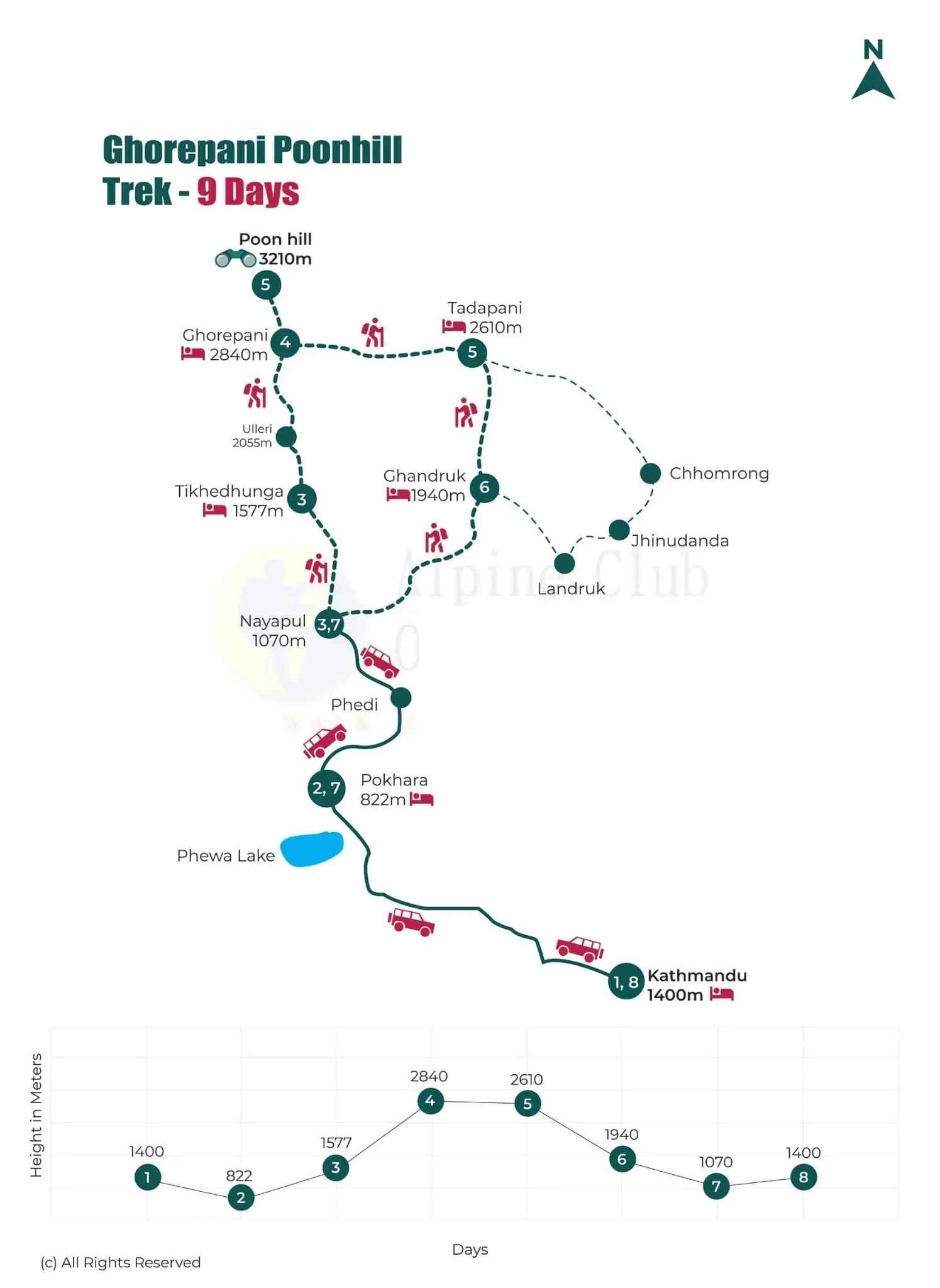


Overview
Duration
9 Days

Country
Nepal

Maximum Altitude
3210m

Group Size
Min 1 pax

Activities
Trekking

In the middle of the Annapurna Conservation Area, the Ghorepani PoonHill Trek is one of the few short, well-known, and easy trails for trekking. It’s also called the Annapurna Sunrise Trek and the Annapurna Panorama Trek. Offering a great chance to see the most stunning views of central hills, mountains capped with snow, and charming towns. Finding out about the locals’ customs, way of life, and culture.
A quick look at the Ghorepani PoonHill Trek: It starts with a drive from Kathmandu to Pokhara, the city of lakes. Following the rapids of the Trishuli and Marsyangdi rivers, going through many settlements and long, green hills that never end. In Pokhara, you can visit the narrow, deep gorge of the raging Seti River, as well as the waterfalls and cave networks. Also, check out some of the city’s other interesting sights. After seeing what Pokhara has to offer, take a short drive to Nayapul. A lot of different treks in the area start in Nayapul.
Nayapul then went in the direction of Thikhedhunga. Walking through the forests on trails that cross streams, waterfalls, and different villages. From Thikhedhunga, go to the small village of Ghorepani. Going up and down a well-kept set of stone stairs and through beautiful oak and rhododendron forests. At, Ghorepani go out and learn about the locals’ culture and way of life.
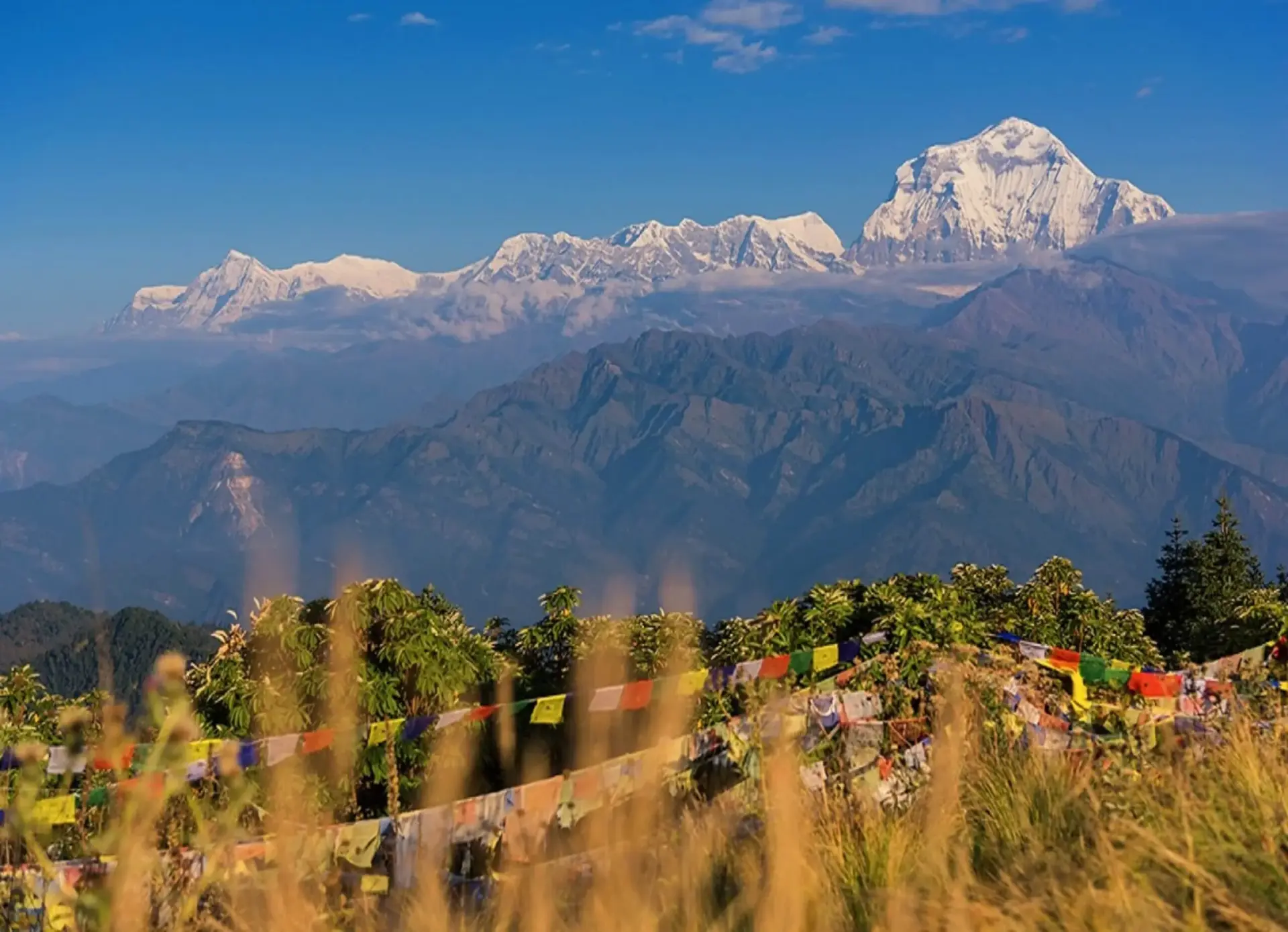
Next, head towards Poon Hill, which is known for its great views. Travelling along a well-marked and well-kept path. From the top, you can see the sunrise in a big way. Some of the tallest mountains in the world are Annapurna South, Annapurna I (8091 m), Hiunchuli (6441 m), Tarke Kang (7193 m), and Machhapuchhre (6,993 m). All of them stood in awe of its beauty and changed colours as they soaked up the morning sun. After taking in the stunning views, go downhill and wind your way through a mossy Rhododendron forest, deep gorges, and along a clear creek until you reach the village of Ghandruk.
Gondruk
One of the most well-known villages in the area is Ghandruk. You can learn about the people who live here by going to the museum. The next day, you can get to Nayapul by trekking through lush forests. From here, go to Pokhara, and the next day, you’ll get to Kathmandu.
The Ghorepani PoonHill Trek gives you the chance to see beautiful natural scenes and learn about the customs and cultures of different ethnic groups. Join the Alpine Club of Himalaya on this short walk in the Annapurna Conservation Area.
Entry and Permits:
To go on the Ghorepani PoonHill Trek, you need the following permits:
- Foreigners must pay 3,000 NPR (about $30) to get an ACAP entry permit.
- The fee for an ACAP entry permit for Indian citizens is 2000 NPR.
- TIMS Permit: NRP 1,000 per person for treks that are planned by a company
- NRP 2,000 per person for trekkers who are going on their own (without a guide or porter).
Note:
The Alpine Club of Himalaya takes care of all the trekking permits.
Water and meals:
On the Annapurna Region Trek, you will be served a variety of Nepalese and Tibetan dishes, as well as continental and western foods. Along the trail, people from the area run a number of teahouses with basic to high-end amenities. Trekkers can try a variety of foods at these teahouses, which isn’t common on most Nepalese trekking trails.
As of now, the Annapurna Region does not allow the use of plastic bags or mineral water bottles. The walk has natural water sources with taps that are easy to reach along the way. But keep in mind that this water hasn’t been treated and isn’t safe to drink. You can fill up your water bottle at any of the teahouses along the trail with either hot water that has been boiled or cold water that has been filtered.
If you want to be even safer, save money, and help clean up the environment, buy a water purification tablet, chlorine drops, or use SODIS (sunlight assisted) filtration methods.
Accommodations:
Hotels, lodges, and other places to stay that are friendly to tourists can be found along trekking trails. These range from simple rooms to fancy and luxurious ones. From high-end hotels to cosy teahouses, the trail has something for everyone. The hotels and teahouses have comfortable beds with pillows, electric blankets, hot and cold showers, free Wi-Fi, and more.
The teahouses in the Annapurna region have hot showers and western-style bathrooms that are attached to the rooms. The rooms usually have a single bed, good mattresses, a pillow, and blankets, and there is a clean and healthy atmosphere.
Along the trail, there are also campsites that offer campers a unique chance to sleep under the stars.
When is the best time to go?
This area’s best times to go trekking are in the autumn and spring.
The best times to go are in September, October, November, March, April, and May. In terms of weather and visibility, these months are better.
The months of September, October and November in the autumn are some of the best for trekking in this area. The weather is clear, so you can see the endless mountain ranges and lush green forests clearly, and the nights are clear, so you can look at the stars.
The Annapurna Region is also at its most beautiful in the spring, in March, April, and May. The end of winter brings about a change in the area, with different kinds of trees blooming in the sub-alpine forest, high green pasturelands covered with wildflowers, mild temperatures, and clear skies. Sheep and yaks will be grazing in large groups in the green highlands this time of year.
The monsoon season is not good because the weather is bad and it’s hard to get around the country because of the frequent rainstorms and landslides. So, trekkers try to avoid the monsoon season as much as possible.
In the winter, the Annapurna Region gets a lot of snow, which covers most of the trails and makes it impossible to travel.
Travel insurance:
All clients who do any kind of activity must have travel insurance. An all-around insurance plan from a reputable company can protect your finances in many situations. In a lot of different situations, our travel insurance plan will actively cover you. We suggest that you get travel insurance so that you are fully covered in case something goes wrong. The plan covers things like personal injury, death benefits, hospital bills, repatriation costs if you get hurt abroad, helicopter rescue if needed, and even some diseases.
Passport and Visa:
All clients must have a passport that is valid for at least six months before their return date. This can be checked at the Nepalese consulate in your country or at the Tribhuvan International Airport in Kathmandu.
At the Alpine Club of Himalaya, your safety is the most important thing to us. We can cancel the trip or change the plans at any time if we think it’s necessary or if we have reason to believe that your safety is at risk. When travelling in remote mountain areas, things like bad weather, natural disasters, the health of a group member, and other things can cause changes to the plan. We kindly ask that you fully support the trusted leader of the group chosen by the Alpine Club of Himalaya in these very dangerous situations. We promise, though, that we will do everything we can to stick to the above schedule.
Gallery
Itinerary
When you get to Kathmandu’s Tribhuvan International Airport. An Alpine Club of Himalaya representative will help you find a place to stay. When you get to your hotel, take a break. After that, go to a briefing about the trip. In the evening, you can join a special dinner program where you can eat delicious Nepalese food.


Max. Altitude:
1400m

Hotel

Meal
Welcome Dinner
Take a long drive to Pokhara after breakfast. By following the Prithvi Highway’s winding roads and going through several towns. As soon as you get to Pokhara, go to your hotel. Take a short break, and then go enjoy the city’s sights. You can see the roaring Seti River’s deep, narrow gorge and the famous Davi’s Falls. You can also explore the networks of Gupteshwar Cave and the Bat Cave. Also, check out the museums in the area. After that, go to Phewa Lake to watch the sun go down.


Max. Altitude:
822m
Hotel
Meal
Breakfast, Lunch, Dinner
You can see the Himalayas from some parts of the 41 km (25 miles) drive through high hills. When you get to Nayapul, you’ll begin your hike. To get to the village of Birethanti, start by going up a steep path through the dense forest. After a while, the path will drop to a bridge over a small stream. From Birethanti, take the trail that goes left on the west side of the bridge. As you walk, you’ll reach the Annapurna Conservation Area Project Check post.
After having your ACAP permits checked, go towards Birethanti. Through the bamboo forest, you can reach the village of Sudami, which has a big waterfall and a swimming hole. From here, go up a hill on the side of the valley until you reach Hille. You can get to the settlement of Thikhedhunga after a short walk from here.

Max. Altitude:
1577m
Hotel
Meal
Breakfast, Lunch, Dinner
Start by going through a very wild area and crossing the Thikhedhunga Khola on a suspension bridge. As you go on, you’ll cross another set of rivers in the Bhurungdi Khola on a big bridge that is 1520 meters above sea level. After that, you will be going up a steep part of a well-kept set of more than 3300 stone stairs that will lead you to Ulleri, a large Magar village at an elevation of 2080 meters.
Also, if you keep going past the pastures and lush farm fields, you’ll find the deep forest trails. You will get to Banthanti if you follow the path. From Banthanti, you can walk through beautiful oak and rhododendron forests, across several crystal-clear streams, and over a small ridge to reach the Magar village of Nangathanti, which is 2460 meters above sea level. Along this stretch, you can see eight different kinds of rhododendrons, which are Nepal’s national flower. You will finally get to the settlement of Ghorepani after a short walk from Nangathanti.

Max. Altitude:
2840m
Hotel
Meal
Breakfast, Lunch, Dinner
Today, get up early and go to the famous Poonhill lookout point. Over two hours are needed to get to the top of the mountain via a well-kept path that goes uphill. As soon as you get to the top, you’ll be able to see the vast wilderness and snow-capped peaks. Dhaulagiri I (8167 m), Tukuche (6920 m), Nilgiri (6940 m), Annapurna South, Annapurna I (8091 m), Hiunchuli (6441 m), Machhapuchhre (6,993 m), and Tarke Kang are the mountain peaks that stretch from Dhaulagiri to Annapurna to Machhapuchhre.
All of them stood in awe of its beauty and changed colours as they soaked up the morning sun. Next, the trek goes through lush forests and rice fields with terraces. Along the way, it stops at cute villages. When you get to the village, take it easy and rest. At 2,630 meters above sea level, Tadapani has stunning views of the mountain range nearby. Spend the night at the Guest House.


Max. Altitude:
3210m
Hotel
Meal
Breakfast, Lunch, Dinner
Take it easy today because most of the trail goes down. Start your journey by going through a mossy Rhododendron forest, along a clear creek, and through deep gorges. From this part, you can see the old-growth forest and the snow-white loft peaks in all their glory. As you go down this trail, you’ll leave the wild and enter a dryer, more open forest. You will finally reach the settlement of Ghandruk after a short walk. When you get to Ghandruk, go to the museum to learn about the people who live there and their customs. Come back to your teahouse and watch the sunset from the porch after a day of exploring the area.


Max. Altitude:
2610m
Hotel
Meal
Breakfast, Lunch, Dinner
While you eat your breakfast, take in the view of the mountains and the sunrise. After taking in the stunning views, keep going south on the main trail. Going up and down a set of stairs and then following the high route above the raging river on a stone-paved path. As you go on, you’ll reach the small village of Chane at an elevation of 1690 meters and Kimche at the same elevation.
Next, take a trail that goes downhill towards the Modi Khola. This will lead you to Syauli Bazaar, which is in the middle of the jungle and 1140 meters above sea level. From here, you can walk on flat ground along the river network through a beautiful birch forest and rice terraces to get to Birethanti. You will finally get to Nayapul after a short walk from Birethanti. Going back to Pokhara from Nayapul is the next step. When you get to Pokhara, take a short break and then go explore the Phewa Lake. After that, go to some restaurants and pubs in the area.
Max. Altitude:
1940m (Ghandruk)
Hotel
Meal
Breakfast, Lunch, Dinner
After breakfast, take the winding Prithvi Highway to get to the Kathmandu valley. When you get to Kathmandu, go to where you’re staying. In the late evening, you can join a farewell dinner program to mark the end of your trip.

Max. Altitude:
1400m
Hotel
Meal
Breakfast, Lunch, Dinner
You are going back to your country today. A member of the Alpine Club of Himalaya will pick you up at the airport. You can get in touch with Alpine Club of Himalaya – Walk of the Himalaya if you have any questions or need help or more information about this trip or any other trip.
Note that all of the above trekking times are estimates and should only be used as a general guide.


Max. Altitude:
Hotel
Meal
Official Everest Base Camp Trek Map