

Overview
Duration
12 Days

Country
Nepal

Maximum Altitude
5545 (Kala Patthar)

Group Size
Min. 1 Pax

Activities
Trekking

If you want to see the most beautiful and exciting parts of the Khumbu region, join our Everest Aggressive Trek. In the northeast of the country, in the Mahalangur section of the larger Himalayan range, lies the Khumbu region. UNESCO has named the area a world heritage site and it is part of Sagarmatha National Park. In the north, the park goes all the way to Tibet. In the east, it ends at Makalu Barun National Park, and in the south, it ends at the Dudh Koshi river. It is home to a lot of different kinds of plants and animals and climates. You will be going on an adventure of a lifetime on this Everest Base Camp Aggressive Trek. You will see natural wonders and learn about cultures that have been frozen in time.
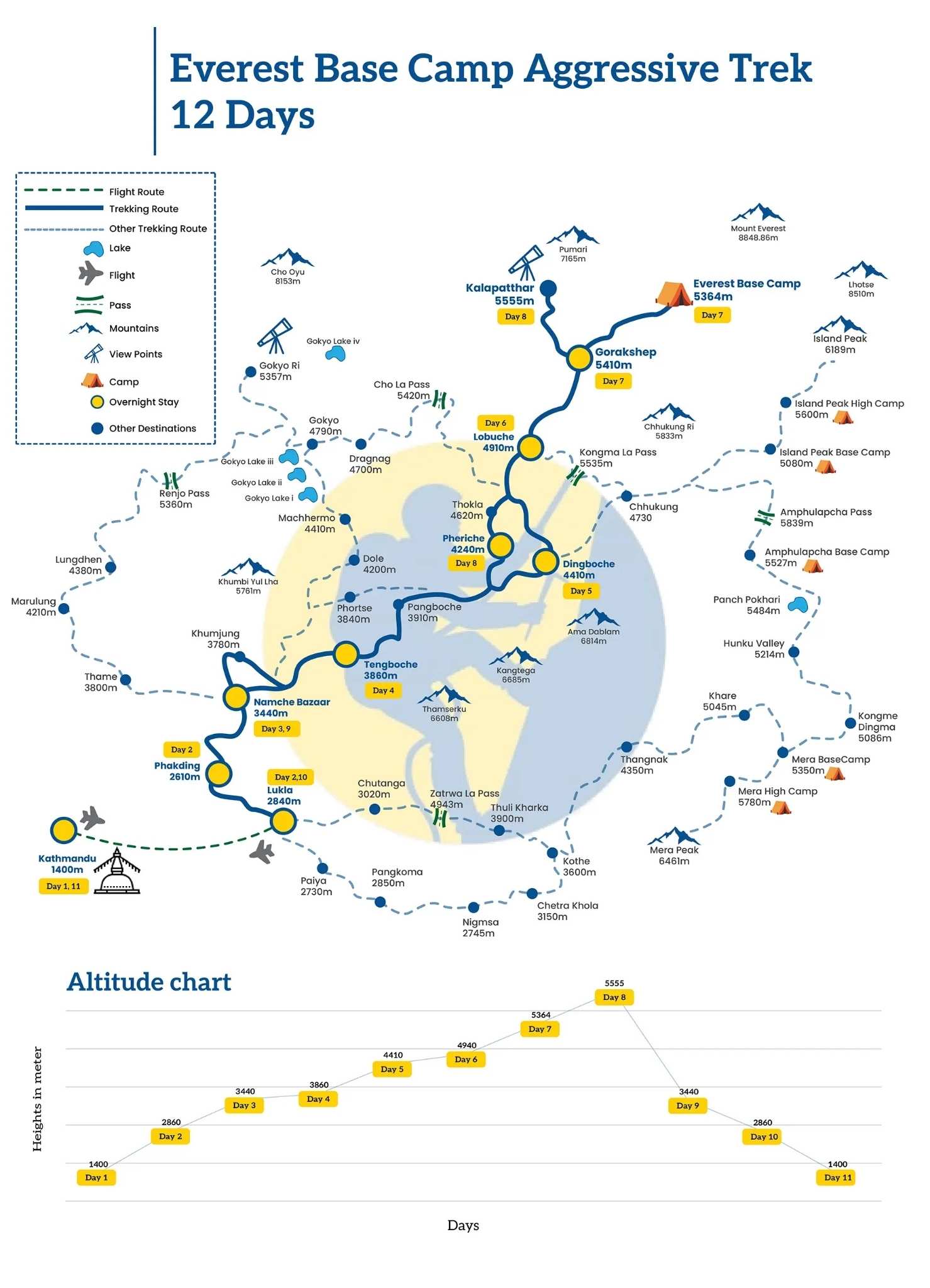
Base Camp for Everest A scenic flight from Kathmandu to Lukla is the first part of the tough trek. You’ll go through subtropical forests to get to Namche Bazaar, which is the capital of the Sherpa people and has a lot of services. Before you get to Tengboche village, you’ll see Everest as you keep going along a high path. You can visit the old Tengboche Monastery here, which is set at 3867 meters in beautiful mountain scenery.
You’ll go down to Imja Khola, through the villages of Pangboche and Pheriche, and then you’ll reach the Khumbu Glacier. You’ll get to Lobuche village by crossing moraines. The next day, you’ll walk to Gorakshep and then to Everest Base Camp, where you can take in the stunning view of the Himalayas. Next, you’ll go up Kala Patthar, which is the trek’s highest point at 5,545 meters. The climb isn’t difficult, but be careful because of the high altitude. You can get amazing views of Everest, Nuptse, Lhotse, the Khumbu glacier, and more from Kala Patthar. You’ll go back over the same paths you took, through towns and wild areas, to get to Lukla. The trek ends in Kathmandu.
This Everest Base Camp Aggressive Trek is especially hard because you won’t have any days to get used to the altitude or the long distances. So, the trek is made for people who are in good shape and have done some trekking before but don’t have a lot of time. The Alpine Club of Himalaya wants you to join them on this exciting trek.
The Best Times of the Year
Autumn and spring are the best times to go trekking in the Everest region. These are September, October, November, March, April, and May.
In the autumn, from September to November, the weather is clear, warm and you can see a lot. It’s easy to get around the area because the weather is mild.
The spring months of March, April, and May are also the best times to visit the Everest region. Spring marks the end of winter and changes the landscape, bringing to life endless rows of different coloured rhododendron, moss, and orchid-draped trees, colourful undergrowth that goes on for miles, and snowy mountain peaks against a background of clear blue skies.
During the monsoon season, the weather is bad for trekking, and it’s hard to get around the country because of all the landslides and floods. Trekkers usually stay away from the monsoon season.
As winter approaches, the area gets a lot of snow, which covers most of the trail. Most parts of Everest are also closed off, so it’s not possible to trek.
At the Alpine Club of Himalaya, your safety is the most important thing to us. We can cancel the trip or change the plans at any time if we think it’s necessary or if we have reason to believe that your safety is at risk. When travelling in remote mountain areas, things like bad weather, natural disasters, the health of a group member, and other things can cause changes to the plan. We kindly ask that you fully support the trusted leader of the group chosen by the Alpine Club of Himalaya in these very dangerous situations. We promise, though, that we will do everything we can to stick to the above schedule.
Gallery
Itinerary
The flight to Nepal is amazing, with views of mountain ranges that go on forever. When you get to Kathmandu International Airport, someone from the Alpine Club of Himalaya will greet you and help you find a place to stay. You are free to explore this historic and lively city for the rest of the day. You can walk around the city on your own or with a guide. In the evening, there will be a welcome dinner and then a meeting to talk about the trek.


Max. Altitude:
1400m

Hotel

Meal
Breakfast, Lunch, Dinner
Following breakfast, you should go to the domestic airport and then to Lukla. Linz is a small town in the Khumbu region that sits on top of a hill. People see the settlement as the entrance to Everest. After a short break when you get to Lukla, you will begin your trek to Phakding. As you go down from the terraced farms and agricultural belts, you will see the villages of Chheplung, Ghat, Sano, and Thulo Gumela. Check out the old monasteries of Drangdrak Gompa and Pema Choling Gompa as well. From there, you can see the sacred mountain Kumbila and its sister peak, Kusum Kanguru peak. From here, it’s only a short walk to the settlement of Phakding.

Max. Altitude:
2860m (Lukla)
Hotel
Meal
Breakfast, Lunch, Dinner
Get up early and start your walk to Namche Bazar after breakfast. As you pass through the villages of Zamphute and Tok Tok, you’ll see Mt. Thamserku shining in the early morning sun, which will stay with you for most of the day. As you walk along the trail, you will see the beautiful Sherpa villages of Benkar, Chumoa, and Monjo. Moving forward along the powerful Dudhkhosi river, you will soon reach the buffer zone of the Sagarmatha National Park, which has been named a UNESCO World Heritage Site. Check out the Utche Choling Gompa on the way.
Your half-trip for today will be over once your permits are checked at the National Park entrance. From here on out, you’ll be going through steep parts of the lush forests. After going through the village of Jorsale, there is a steep, stepped path that leads to a beautiful high bridge over the Dudh Koshi River gorge. Just before this bridge, the Bhote Koshi, a branch of the Dudh Koshi, meets it. As you go up this trail, you’ll get your first look at Mt. Everest through the Lhotse-Nuptse ridge. After about a 1.5 km/0.9 mile hike, you’ll reach Namche Bazar. When you get to Namche Bazaar, you should go see some of the area’s sights.


Max. Altitude:
3440m
Hotel
Meal
Breakfast, Lunch, Dinner
Taking the easy, level trail from Namche that goes along the ridge gives you a great view of the landscapes, including Everest, Ama Dablam, Lhotse, Thamserku, and many other mountain peaks. From this point, go to Kyangjuma, a village at an elevation of 3550 meters, and then go to Sanasa, where the trails meet. You can see great views of Ama Dablam as you follow the trail that leads down to Lawichasa.
From Lawichasa, a narrow path goes north to Tashinga and then drops down on steep stone steps to Phunki Thenga. Cross the bridge and then go uphill for a while. Along this part of the trail, there are woods full of rhododendrons. You will see Mani walls and Chortens as you walk along the trail. These are the first signs of Tengboche village. A wide grassy plain lies below a crescent-shaped ridge that is covered with scrub pines, cider trees, and rhododendrons. The village is nestled in this area. When you get to Tengboche, leave your heavy backpacks behind and go check out the famous Tengboche monastery.
Max. Altitude:
3860m
Hotel
Meal
Breakfast, Lunch, Dinner
Go to the trail after breakfast. In the first part, you’ll be walking through forests with pines, conifers, and rhododendrons. Keep an eye out for local wildlife, like the many monal pheasants and musk deer that live in this area. You will reach the village of Debuche by walking along the trail. In this village, you can visit the Debuche Gompa, which has ancient thangkas and murals painted on wooden panels. On the east side of the hill in Debuche, there is also a small Buddhist nunnery.
From here, the trail goes through a thick forest until it reaches Milinggo. It then drops sharply until it reaches a suspension bridge over Imja Khola. It’s a short walk across the bridge to get to Pangboche village. From there, you can see Ama Dablam at the end of the valley as you walk up a hill. In the village, you can see Pangobche Gompa, which was built by Lama Sange Dorje and is the oldest monastery in Khumbu.
The trail goes uphill as it follows the Imja Khola rapids to the village of Shomare. From here on out, there are no more trees, and you will be travelling through dry landscapes with alpine terrain, patches of scrub, and lone pastures where yaks graze.
Once you get over the yak pasture and stone huts for herders at Orsho and Tsuro Wog, turn right and go down to a place close to where Imja Khola and Khumbu Khola meet. After finally climbing a short ridge, you will reach the large settlement of Dingboche. This is a cold, windy area where the nights are often below zero, even in the summer.

Max. Altitude:
4410m
Hotel
Meal
Breakfast, Lunch, Dinner
The trail we’re on today is full of beautiful natural sights. As you go further, you’ll see rings of mountains all around you. You can get to the settlement of Dusa by taking a short walk. There are stone huts that herders used that are empty. From here, go to Dughla and then Chupki Lhara. There, prayer flags are flown over large piles of stones to remember the mountain climbers who died while trying to reach the top of Mt. Everest.
Chola Lake is at the very top of the valley. The high trail gives you a good view of the turquoise water. The trail drops to the Khumbu glacier moraine from Chupki Lhara. From there, you can see three big peaks: Khumbutse, Lingtren, and Pumori. You will get to the village of Lobuche after a short walk along the stream.

Max. Altitude:
4940m
Hotel
Meal
You need to get going early today because you have a lot to do. Views of the Himalayas can be seen as you walk through high pastures and dry, rocky land with strewn-out boulders. You will have to climb 60 meters (200 feet) to reach Thangma Riju, which is at the top of the Changri Glacier’s moraine wall. From here, you can see the mountains around you in a stunning 360-degree view, including Taboche, Lobuche peaks, Pumori, and the rest of the Mahalangur Himal peaks. In the east, you can see Tibet and Nuptse.
After going over the Changri glacier’s moraine, it eventually meets the Khumbu glacier from the west. Be extra careful because the trails are steep and have rocky sides. After a short walk, you’ll reach Gorak Shep. Come here to get your first look at Kala Patthar. This is a famous spot for seeing the area.
Take a short break at Gorak Shep and then leave your heavy packs there. Then, head to Everest Base Camp. Going around Gorak Shep Lake, which is turquoise, with views of Tibet’s Changtse peak and the Lho La depression. In order to get to Everest Base Camp, you have to go through glaciers, icefalls, frozen pools of meltwater, exposed icy walls, and big rocks. After taking in the view from the foothills of the world’s highest peak, go back to Gorak Shep.
Max. Altitude:
5164m
Hotel
Meal
You start your walk to Kala Patthar after breakfast. This is thought to be the best place to see the Khumbu region from above. Going across a wide, sandy bed of a dried-up lake and on steep, winding turns. As you walk along the trail, you can see Lingtren, Khumbutse, and Changtse, all of which are covered in snow.
From now on, go slowly because the high altitude can make things hard for some. You will reach the top of Kala Patthar by going over some steep parts. See the stunning view of the Himalayas from the top. It has great views of Everest, Nuptse, Changtse, the northern flank of Lhotse, the Khumbu glacier, icefalls, and many other Mahalangur Range mountain peaks. After taking a short break, they went down to Gorak Shep. Follow the same path back to Lobuche as you did to get here. This time, instead of going up to Dingboche, you will go down to Pheriche. If you walk along Khumbu Khola, you will reach the village of Pheriche.

Max. Altitude:
5555m
Hotel
Meal
The path that goes downhill and gives you views of the Himalayas leads to Tsuro Wog and over the Khumbu Khola on a high suspension bridge. From here, start going down, going through the villages of Orsho, Shomare, upper Pangboche, and finally Tengboche. Visit the old Tengboche monastery, which is the largest gompa in the Khumbu region. Next, go through thick forests, passing the villages of Phunki Tenga, Sanasa, and Kyangjuma on your way to Namche Bazar.
When you get to Namche Bazaar, go to your tea house first. Then, go explore the area.
Max. Altitude:
3340m
Hotel
Meal
Go to the trail after breakfast. Going backwards, you can get to Lukla by following the Dudh Koshi river’s banks and walking through lush forests. After a short break when you get to Lukla, celebrate your last night in the mountains and the end of your trek.


Max. Altitude:
Hotel
Meal
Enjoy the mountain views when you wake up. Following breakfast, goes to the airport to catch a flight to Kathmandu. As soon as you land in Kathmandu, go to your hotel. You can take it easy today and walk around the city, picking up gifts and souvenirs for family and friends. Later that night, there will be a farewell dinner show to celebrate the end of your Nepal adventure and the end of your trek.

Max. Altitude:
2860
Hotel
Meal
You will have free time today until your flight leaves. Someone from the Alpine Club of Himalaya will pick you up at the airport three hours before your flight.
If you’d like to stay longer, you can talk to us about short tours like trips to national parks, rafting, mountain biking, Tibet, India, Bhutan, and more.
You can get in touch with Alpine Club of Himalaya – Walk of the Himalaya if you have any questions or need help or more information about this trip or other trips.
Note that all of the above trekking times are estimates and should only be used as a general guide.

Max. Altitude:
Hotel
Meal
Official Everest Base Camp Trek Map